Material Topics and Management Approaches
Materiality Analysis
To identify material topics, Cheng Shiu University adopted the EU’s Double Materiality approach, aligned with the AA1000 AccountAbility Principles and GRI 3: Material Topics 2021, to assess significant economic, environmental, and social (including human rights) impacts. The process is outlined below:
1 Understand the Organizational Context
The University reviewed its operating model and value chain, incorporating international sustainability standards, global trends, sustainability assessment criteria, benchmarking institutions, and stakeholder feedback. Similar and overlapping topics were consolidated to identify 28 sustainability topics, as shown below.
|
University Governance (G) |
Institutional Reputation & Brand Image University Governance & Risk Management Regulatory Compliance Academic Ethics Financial Management Talent Development & Retention Teaching Resources & Learning Environment Privacy Protection & Information Security Academic Performance AI & Digital Transformation for Sustainability Stakeholder Engagement |
|
Environmental Sustainability (E) |
Climate Governance & Action Energy Management & Conservation Water Resource Management Waste Management & Recycling Campus Environmental Safety Procurement & Supplier Management Campus Ecology & Environmental Protection Occupational Health & Safety |
|
Social Inclusion (S) |
Equity & Well-being Student Physical & Mental Well-being Financial Aid Measures Student Internships & Employment Research & Industry-Academia Collaboration Alumni Engagement University Social Responsibility (USR) Global Partnerships Education for Sustainable Development (ESD) |
2 Identify Impacts and Assess Their Significance
The University assessed the actual and potential positive and negative impacts of its activities on the economy, environment, and society, including their likelihood, significance, and potential influence on University operations.
A. Assess Sustainability Impacts
For the 28 identified sustainability topics, the University assessed their actual and potential positive and negative impacts. Fourteen senior University executives completed an impact assessment to evaluate the likelihood and significance of each impact.
B. Assess Impacts on University Operations
The University evaluated the potential effects of each sustainability topic on its operations using five key factors: student enrollment/service revenue, institutional reputation, operating costs, funding and subsidies, and legal liability. Each factor was rated on a five-point scale.
C. Assess Stakeholder Concern
Through the 2025 Stakeholder Sustainability Survey, the University collected 1,515 responses from 10 stakeholder groups. After excluding 109 invalid responses, 1,406 valid responses were analyzed to determine and rank stakeholder concern for each sustainability topic.
3 Prioritize Impacts
1. Sustainability Impact Assessment
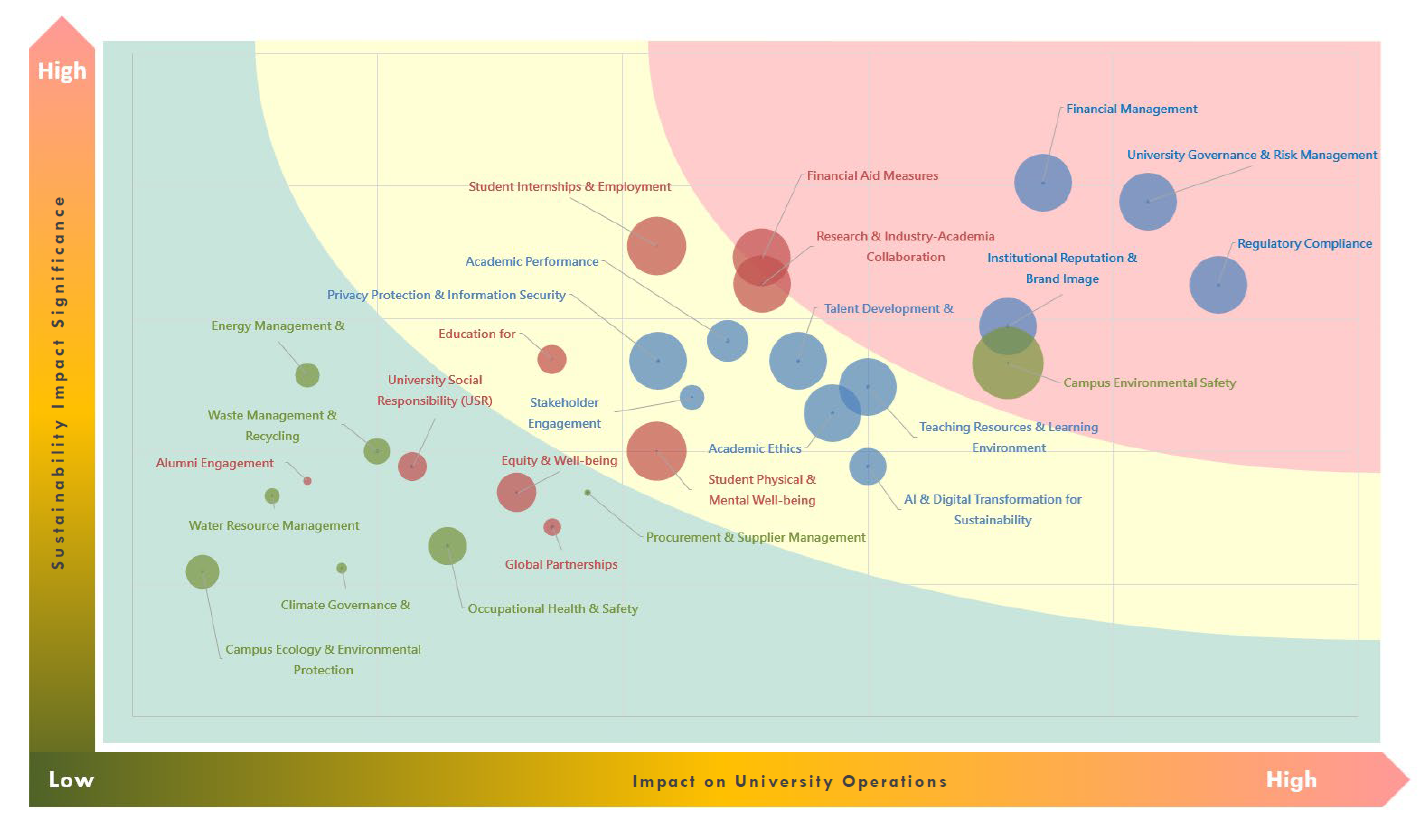
The sustainability impact score was determined by comparing the positive and negative impact scores and adopting the higher value (Max) as the final score. This score served as the Y-axis of the materiality matrix.
Positive Impact = ((Scope + Severity) ÷ 2) × Likelihood
Negative Impact = ((Scale + Irremediability) ÷ 2) × Likelihood
2. Impact on University Operations
The operational impact score for each topic was calculated by summing the scores of five operational impact factors and normalizing the result to a 0–1 scale for comparison across topics. This score served as the X-axis of the materiality matrix.
Operational Impact = (Total score of the five operational impact factors) ÷ (Maximum possible survey score)
3. Stakeholder Perspective
To reflect the relative importance of different stakeholder groups, weighted scores were applied to stakeholder concern for each sustainability topic. The results are presented as bubble sizes in the materiality matrix to support material topic identification.
Stakeholder Concern = Σ (Stakeholder concern score × Stakeholder weighting)
Stakeholder concern was ranked for each stakeholder group, with the top one-third of topics identified as high-priority topics.
4 Determine Material Topics
Based on the assessment results, Cheng Shiu University identified nine material topics by integrating sustainability impacts and operational impacts: University Governance & Risk Management, Financial Management, Regulatory Compliance, Institutional Reputation & Brand Image, Campus Environmental Safety, Financial Aid Measures, Research & Industry-Academia Collaboration, Student Internships & Employment, and Teaching Resources & Learning Environment.
To reflect its commitment to environmental sustainability and stakeholder expectations, the University additionally included Energy Management & Conservation, Student Physical & Mental Well-being, and Academic Ethics. Following approval by the Social Responsibility and Sustainable Development Committee, 12 material topics (9 + 3) were confirmed for 2025.
Ranked by significance, the 12 material topics are: University Governance & Risk Management, Financial Management, Regulatory Compliance, Institutional Reputation & Brand Image, Campus Environmental Safety, Financial Aid Measures, Research & Industry-Academia Collaboration, Student Internships & Employment, Teaching Resources & Learning Environment, Academic Ethics, Student Physical & Mental Well-being, and Energy Management & Conservation.
2025 Material Topics
|
University Governance (G) |
Environmental Sustainability (E) |
Social Inclusion (S) |
|
University Governance & Risk Management Financial Management Regulatory Compliance Institutional Reputation & Brand Image Teaching Resources & Learning Environment Academic Ethics |
Campus Environmental Safety Energy Management & Conservation |
Financial Aid Measures Research & Industry-Academia Collaboration Student Internships & Employment Student Physical & Mental Well-being |
5 Review and Approve Material Topics
A total of 12 material topics were identified for 2025, including one new topic—Institutional Reputation & Brand Image. of these, seven align with the GRI Standards and SASB, while five are University-specific topics.
In accordance with the GRI Standards, the University discloses its management approach, commitments, targets, and performance for each material topic to address stakeholder concerns. Materiality assessments are conducted annually to monitor emerging sustainability issues and track progress toward long-term sustainability goals.
Changes in Material Topics
|
2025 Material Topics |
2024 Material Topics |
Change |
Description |
|
Institutional Reputation & Brand Image |
- |
Added |
Added in response to stakeholder feedback to strengthen student recruitment, industry–academia collaboration, and international engagement through a strong institutional reputation and brand image. |
|
Teaching Resources & Learning Environment |
Infrastructure & Facilities |
Renamed |
Renamed to better reflect its broader scope, covering campus buildings, learning environments, teaching facilities, and practical training spaces. |
|
Student Internships & Employment |
Career Development & Industry-Academia Collaboration |
Split |
Emphasizes practical learning, internships, career guidance, and employment services. |
|
Research & Industry-Academia Collaboration |
Split |
Emphasizes research excellence and the University's external impact through industry–academia collaboration. |
|
|
- |
Academic Performance |
Reclassified |
Reclassified as a general topic in 2025. Related disclosures remain available in Section 3-3, Academic Performance. |
|
- |
Education for Sustainable Development (ESD) |
Reclassified |
Reclassified as a general topic in 2025. Related initiatives and achievements remain disclosed in Section 3-7, Education for Sustainable Development (ESD). |
Material Issue Matrix
Material Issue Description
In 2025, Cheng Shiu University identified 12 material topics through its materiality assessment, covering governance, environmental, and social dimensions. Governance topics include University Governance & Risk Management, Financial Management, Regulatory Compliance, Institutional Reputation & Brand Image, Teaching Resources & Learning Environment, and Academic Ethics. Environmental topics include Campus Environmental Safety and Energy Management & Conservation. Social topics include Financial Aid Measures, Research & Industry-Academia Collaboration, Student Internships & Employment, and Student Physical & Mental Well-being.
Through diverse stakeholder engagement channels, the University identifies the impacts of these material topics on its operations, society, and the environment, and develops corresponding management approaches and actions. Implementation results are regularly reviewed to strengthen sustainability governance and support continuous institutional development.
|
Material Issue |
Corresponding Standards & SDGs |
Significance to CSU and Explanation of Operational Impact |
Activities Involving Negative Impact |
Response Actions |
||
|
Upstream |
CSU |
Downstream |
||||
|
University Governance & Risk Management |
SASB ED-000 Activity Metrics |
Performance indicators include, but are not limited to, freshman enrollment rates, recruitment strategies, teacher-student ratios, and teaching quality. Strong performance can enhance the university’s reputation, attract more students and investment, while poor performance may cause enrollment challenges and a negative campus atmosphere. |
○ |
● |
○ |
.Secure Ministry of Education funding to support teaching enhancement initiatives. .Strengthen teaching quality assurance through rigorous curriculum review and quality management. .Encourage faculty professional development to enrich curriculum content and teaching innovation. |
|
Financial Management |
GRI 201 Economic Performance SASB ED-270 Marketing & Recruiting Practices |
Procurement and expenditure processes are established under the principles of fairness, openness, and impartiality, with regular audits. A systematic financial management policy optimizes financial operations and maintains profitability; conversely, poor management could lead to declining year-end cash and bank balances, increased debt ratios, and heightened financial loss risks. |
○ |
● |
○ |
.Financial statements are audited twice annually by independent certified public accountants to ensure reliability. .Diversify funding sources and strengthen internal control mechanisms. |
|
Regulatory Compliance |
Customized issues |
Our university strictly adheres to legal compliance, fostering a positive campus culture, reducing operational risks, and enhancing management performance. Compliance with laws and regulations brings a positive public image, while non-compliance could result in negative media coverage, penalties, reputational damage, and declining student enrollment. |
○ |
● |
● |
.Maintain a dedicated platform for institutional policies and regulations. .Implement an internal control system, supported by the Office of Internal Audit, to conduct annual internal audits and control reviews. |
|
Institutional Reputation and Image |
Customized issues |
A strong institutional reputation enhances public trust and attracts talented faculty, students, and industry partners. Conversely, negative incidents or media coverage may damage the University's reputation, hinder student recruitment and industry collaboration, and weaken stakeholder confidence and support. |
○ |
● |
● |
.Strengthen governance and risk management to safeguard institutional reputation and public trust. .Publish annual sustainability reports and participate in sustainability assessments to enhance transparency and institutional reputation. .Advance University Social Responsibility (USR) and sustainability initiatives to strengthen engagement with students, industry, and local communities. |
|
Teaching Resources and Learning Environment |
GRI 203 Indirect Economic Impact |
The University plans and develops infrastructure while regularly upgrading software and hardware facilities to ensure teaching quality. Without these efforts, students may experience poor online learning outcomes, faculty may lack adequate teaching equipment, and campus facilities may deteriorate. |
○ |
● |
● |
.Upgrade digital systems and replace aging equipment. .Expand library and online learning resources to support digital teaching and learning. .Establish certification training facilities to provide diverse hands-on learning environments. .Upgrade the campus core network infrastructure to enhance overall network performance. |
|
Academic Ethics |
GRI 205 Anti-corruption |
The University regularly promotes the principles of academic ethics to faculty and students and ensures their integration into teaching practices to gain societal trust and support. Conversely, neglecting these principles could lead to reputational damage, a decline in academic integrity, and enrollment challenges. |
○ |
● |
● |
.Establish an Academic Ethics Committee and implement policies on academic ethics and thesis quality assurance. .Provide academic research ethics training for faculty and students. .Require academic ethics education for graduate students as a compulsory course or graduation requirement. .Publish Guidelines for the Use of Generative AI in Teaching and Learning to promote the ethical and responsible use of AI. |
|
Campus Safety |
Customized issues |
The university supervises campus environmental and safety measures by regularly inspecting disaster prevention and response facilities and conducting awareness programs, ensuring no negative impact on surrounding communities and safeguarding the safety of faculty, staff, and students. |
○ |
● |
● |
.Establish a Campus Safety and Emergency Response Center. .Maintain a University Traffic Safety Committee to strengthen campus traffic safety management. |
|
Energy Management & Conservation |
GRI 302 Energy GRI 305 Emissions |
The university replaces outdated equipment and actively implements energy-saving management to reduce campus electricity costs, while encouraging suppliers and partner companies to participate in such initiatives. Without energy-saving measures, the university would face increased electricity expenses and additional greenhouse gas emissions. |
○ |
● |
○ |
.Conduct annual greenhouse gas inventories and monitor carbon reduction performance. .Promote green procurement by prioritizing eco-labeled products. .Continuously optimize short-, medium-, and long-term energy- and water-saving measures. |
|
Financial Aid Measures |
Customized issues |
To encourage outstanding students, as well as those from economically disadvantaged and underprivileged backgrounds, the university offers various scholarships and financial aid programs to help students complete their studies, reduce financial burdens, and ensure equal educational opportunities. Conversely, the absence of a comprehensive financial aid mechanism may cause economically disadvantaged students to drop out due to tuition pressure, affecting personal development and potentially reducing the accessibility of education and opportunities for upward social mobility. |
○ |
● |
○ |
.Provide comprehensive financial aid, including living grants, emergency assistance, housing subsidies, and student support programs. in AY2024, scholarships and financial aid totaled NT$70.98 million, benefiting 10,969 students. .Operate a Special Education Resource Center to support students with disabilities. .Operate an Indigenous Student Resource Center to support Indigenous students' academic success. |
|
Research & Industry-Academia Collaboration |
SASB ED-260Quality of Education &Gainful Employment |
By promoting industry collaboration, interdisciplinary research, and resource sharing, the University enhances industrial competitiveness while strengthening students’ practical skills and employability. Without effective implementation, academic–industry cooperation and student engagement may be limited, weakening talent development and institutional capacity. |
○ |
● |
● |
.Strengthen industry–academia collaboration and interdisciplinary research to enhance R&D capacity and strategic industry partnerships. .Promote hands-on learning, capstone projects, and industry co-teaching to strengthen students' practical skills and employability. .Integrate internal and external resources with industry partnership platforms to advance technology innovation, knowledge transfer, and talent development. |
|
Student Internships and Employment |
SASB ED-260Quality of Education &Gainful Employment |
Through practical courses, company visits, internships, job matching, and career guidance, the University broadens students’ perspectives and strengthens their workplace awareness and employability. Without sufficient industry exposure, students may struggle to understand market needs, resulting in skills gaps and reduced career competitiveness. |
○ |
● |
● |
.Provide career guidance to support career exploration and job readiness. .Promote off-campus internships and certification training to strengthen practical skills and professional qualifications. .Operate the Cheng Shiu Job Portal and hold regular career fairs to expand employment matching and workplace connections. |
|
Student Physical and Mental Health |
Customized issues |
The university has established a Counseling Center to provide students with appropriate psychological support. Good physical and mental health not only benefits students’ academic performance but can also positively influence their character and mindset. Conversely, students may be more prone to feelings of anxiety and sadness. |
|
● |
● |
.Conduct mental health screenings and provide counseling and psychological support services. .Promote campus health programs to enhance students' health literacy. .Deliver smoking cessation, drug prevention, and health education programs to prevent substance abuse. |
Note: For activities involving negative impacts, cause, contribute to, or are directly linked to the impact. ● indicates a significant impact, while ○ indicates a minor impact. Upstream includes suppliers and senior high schools/vocational high schools; downstream includes students, parents, and industry partners.
Material Issue Management
To strengthen the management and governance of material topics, Cheng Shiu University discloses the relevant SDGs, annual performance against targets, and alignment with the University Development Plan for each material topic. The University also outlines its strategies and commitments, short-term objectives, and medium- to long-term plans, while providing references to the corresponding Action Response sections. These disclosures enhance transparency and reinforce the effectiveness of sustainability management.
|
Material Issue |
SDGs |
2025 Target Achievement Status |
Linked to the School Development Project Goal |
||
|
Policy and Commitment |
Short-Term Goal |
Medium to Long-Term Goal |
|||
|
University Governance & Risk Management |
|
|
Strategy one: Ensure the quality of teaching to attain sustainable teaching excellence Strategy seven: Comprehensive resource planning to enhance organizational performance Strategy Eight: Improve school administration management to sustain school development |
▸ Maintain an undergraduate retention rate of at least 80% for daytime bachelor's programs. ▸ Strengthen internal controls through regular audits and self-assessments. ▸ Publish an annual Accountability Report. ▸ Conduct two professional enrollment workshops each year. |
.Optimize academic programs and organizational structure in response to industry trends and enrollment needs. .Promote digitalized administrative processes to enhance institutional management efficiency. .Strengthen internal controls, internal audits, and institutional research to improve governance and risk management. .Enhance enrollment strategies and student selection mechanisms to strengthen recruitment quality and institutional accountability. |
|
Financial Management |
|
|
Strategy seven: Comprehensive resource planning to enhance organizational performance |
▸ Maintain non-tuition revenue at 40% of total revenue. ▸ Conduct two annual independent audits and prepare annual financial statements. ▸ Conduct annual internal audits to strengthen the reliability of financial reporting. |
.Expand industry–academia collaboration and secure external funding and competitive grants. .Achieve a 100% pass rate in the Ministry of Education's triennial financial audits conducted by independent accountants. .Disclose financial performance and operating results on the University website to strengthen stakeholder trust and transparency. |
|
Regulatory Compliance |
|
|
Strategy one: Ensure the quality of teaching to attain sustainable teaching excellence Strategy seven: Comprehensive resource planning to enhance organizational performance Strategy Eight: Improve school administration management to sustain school development |
▸ Regularly review and update institutional policies and regulations in accordance with administrative procedures. ▸ Conduct annual internal reviews of all 23 academic departments to support continuous development. ▸ Conduct regular institutional self-evaluations and undergo external institutional evaluations. |
.Strengthen management mechanisms to safeguard students’ right to education. .Conduct regular reviews, site visits, and evaluations to drive continuous improvement. .Regularly update policies and regulations in response to changing needs to strengthen university governance. .Ensure regulatory compliance and integrity, with a goal of zero violations and zero corruption. |
|
Institutional Reputation and Image |
|
|
Strategy Eight: Improve school administration management to sustain school development |
▸ Increase media engagement through interviews with the President and University leaders. ▸ Maintain social media platforms for student recruitment. ▸ Participate in at least five sustainability or University Social Responsibility (USR) awards and assessments annually to drive continuous improvement. |
.Strengthen the promotion of the University's distinctive strengths and educational achievements. .Enhance student recruitment through targeted media outreach and partnerships with feeder schools. .Integrate university governance, sustainable development, USR, and brand strategies to strengthen institutional competitiveness. |
|
Teaching Resources and Learning Environment |
|
|
Strategy one: Ensure the quality of teaching to attain sustainable teaching excellence Strategy four: Reinforce international exchange to expand the international horizon Strategy six: Create a high-quality environment to elevate artistic cultivation Strategy seven: Comprehensive resource planning to enhance organizational performance |
▸ Continuously upgrade teaching facilities and digital infrastructure. ▸ Develop bilingual teaching and administrative platforms. ▸ Expand library collections and advance AI-enabled library services. ▸ Conduct 10 digital teaching workshops annually and support faculty learning communities to enhance teaching capabilities. ▸ Revitalize the Art Center through hybrid digital art exhibitions. ▸ Continuously improve campus accessibility. ▸ Upgrade and maintain aging buildings and facilities to enhance the campus environment. |
.Develop distinctive teaching, internship, and digital arts learning spaces to strengthen hands-on and innovative learning. .Promote bilingual campus information and facilities, and develop a smart library to enhance internationalization and smart services. .Enhance digital learning environments and accessible facilities to create an inclusive, high-quality campus. .Establish AI learning and practice spaces to foster smart teaching and cultivate interdisciplinary AI talent. |
|
Academic Ethics |
|
|
Strategy one: Ensure the quality of teaching to attain sustainable teaching excellence |
▸ Achieve a 100% professional review rate for graduate theses and dissertations. ▸ Ensure 100% of graduate students complete the Academic Research Ethics Education Program. |
.Strengthen quality assurance for theses and dissertations while reinforcing academic integrity. .Maintain zero academic integrity violations. |
|
Campus Safety |
|
|
Strategy two: Comprehensive Tutoring Network, Guiding Career Development Strategy Five: Strengthening General Education and Fostering Holistic Development |
▸ Continuously enhance campus safety facilities based on annual campus safety assessments. ▸ Establish a mobile campus safety center integrated with the emergency response system to improve incident response efficiency. ▸ Conduct disaster preparedness, earthquake evacuation, and traffic safety education and drills. |
.Establish an integrated campus safety network. .Strengthen safety education for faculty and students. .Enhance safety awareness and emergency response preparedness. |
|
Energy Management & Conservation |
|
|
Strategy seven: Comprehensive resource planning to enhance organizational performance |
▸ Enhance administrative efficiency through integrated campus information systems. ▸ Promote green procurement by prioritizing eco-labeled and energy-efficient products, with annual purchases exceeding NT$10 million. ▸ Replace aging elevators in the Administration Building and student dormitories with energy-regenerative systems. ▸ Replace natural gas boilers in student dormitories with high-efficiency heat pump systems. ▸ Install smart scheduling and access control systems for air conditioning in classrooms, laboratories, faculty offices, and administrative offices. ▸ Implement an Energy Management System (EMS) to integrate electricity, HVAC, solar power, and lighting systems across campus. ▸ Achieve an annual electricity saving rate of at least 1%. |
.Replace drinking fountains used for over eight years with Level 1 energy-efficient models. .Enhance environmental management and advance paperless campus governance. .Promote green procurement and replace aging equipment with energy-efficient alternatives. .Upgrade aging buildings and facilities with high-efficiency, smart energy management systems. .Strengthen environmental education and energy conservation awareness. .Maintain annual electricity savings of at least 1%. |
|
Financial Aid Measures |
|
|
Strategy two: Comprehensive Tutoring Network, Guiding Career Development Strategy Five: Strengthening General Education and Fostering Holistic Development |
▸ Provide targeted academic support for failed courses, achieving a pass rate of at least 80%. ▸ Ensure that over 30% of disadvantaged students benefit from the Comprehensive Student Support Program. ▸ Increase the number of economically disadvantaged students receiving financial assistance by 2% annually. ▸ Strengthen foundational learning through bridge courses, remedial instruction, and ability-based teaching. |
.Implement a Comprehensive Student Support Program that provides academic support, diverse learning opportunities, and scholarships to promote learning in place of part-time work. .Continuously strengthen financial aid measures to support economically disadvantaged students. .Enhance students’ foundational competencies to improve learning outcomes. |
|
Research & Industry-Academia Collaboration |
|
|
Strategy three: Link regional industries to enhance industry-academia collaboration Strategy four: Reinforce international exchange to expand the international horizon |
▸ Secure over NT$400 million in industry–academia collaboration funding, file 40 patent applications, and complete 30 technology transfers. ▸ Form three technical service teams annually to support 40 enterprises. ▸ Launch three domestic and five overseas student industry–academia programs. ▸ Offer at least 15 vocational training courses annually to strengthen professional skills. |
.Strengthen industry–academia R&D mechanisms, faculty–industry engagement, patent applications, and technology transfer. .Align industry–academia programs with national priority industries to cultivate industry-ready professionals. |
|
Student Internships and Employment |
|
|
Strategy two: Comprehensive Tutoring Network, Guiding Career Development Strategy three: Link regional industries to enhance industry-academia collaboration |
▸ Support students in obtaining professional certifications to enhance employability. ▸ Organize at least 20 career development activities annually, including résumé writing, interview preparation, entrepreneurship seminars, career fairs, and alumni sharing sessions. ▸ Conduct regular evaluations and site visits of internship providers to ensure internship quality. ▸ Achieve a 90% response rate and an average satisfaction score of at least 4.0 in graduate employment satisfaction surveys. |
.Strengthen students’ practical skills and enhance faculty teaching and research capacity. .Advance youth employability strategies to bridge the gap between academia and industry and cultivate industry-ready talent. .Conduct regular graduate destination, alumni, and employer satisfaction surveys to support curriculum enhancement and teaching improvement. |
|
Student Physical and Mental Health |
|
|
Strategy two: Comprehensive Tutoring Network, Guiding Career Development Strategy Five: Strengthening General Education and Fostering Holistic Development |
▸ Provide diverse counseling services to support campus adjustment and stress management. ▸ Promote character and life education to foster positive values. ▸ Conduct health screenings and promotion programs, including disease prevention and food hygiene oversight. ▸ Conduct 15 drug prevention awareness activities. ▸ Offer smoking cessation programs and 10 tobacco prevention activities. ▸ Promote adaptive physical education, fitness assessments, and CPR/AED certification training. |
.Integrate counseling resources to support students’ holistic well-being. .Promote character, life, and health education to foster civic literacy and positive values. .Strengthen health promotion, disease prevention, and campus safety education to enhance awareness and emergency preparedness. .Advance drug prevention, a smoke-free campus, and physical education to cultivate healthy lifestyles, lifelong fitness, and first-aid skills. |


Note: Progress is indicated as follows:  fully achieved,
  partially achieved, and
  not achieved.
Sustainability Performance Tracking
To strengthen sustainability performance management, Cheng Shiu University has established an ESG data collection and tracking mechanism to regularly monitor performance across the three ESG dimensions: governance, social, and environmental sustainability. Key indicators include institutional governance, talent development, industry-academia collaboration, social engagement, energy and resource management, and net-zero carbon reduction. Quantitative analysis is used to track performance trends and improvement outcomes, providing a basis for institutional enhancement, resource allocation, and the continuous refinement of sustainability strategies to maximize the University's overall sustainability impact.
Governance |
Environment |
Social |