Sustainable Vision
The Importance and Significance of Sustainability
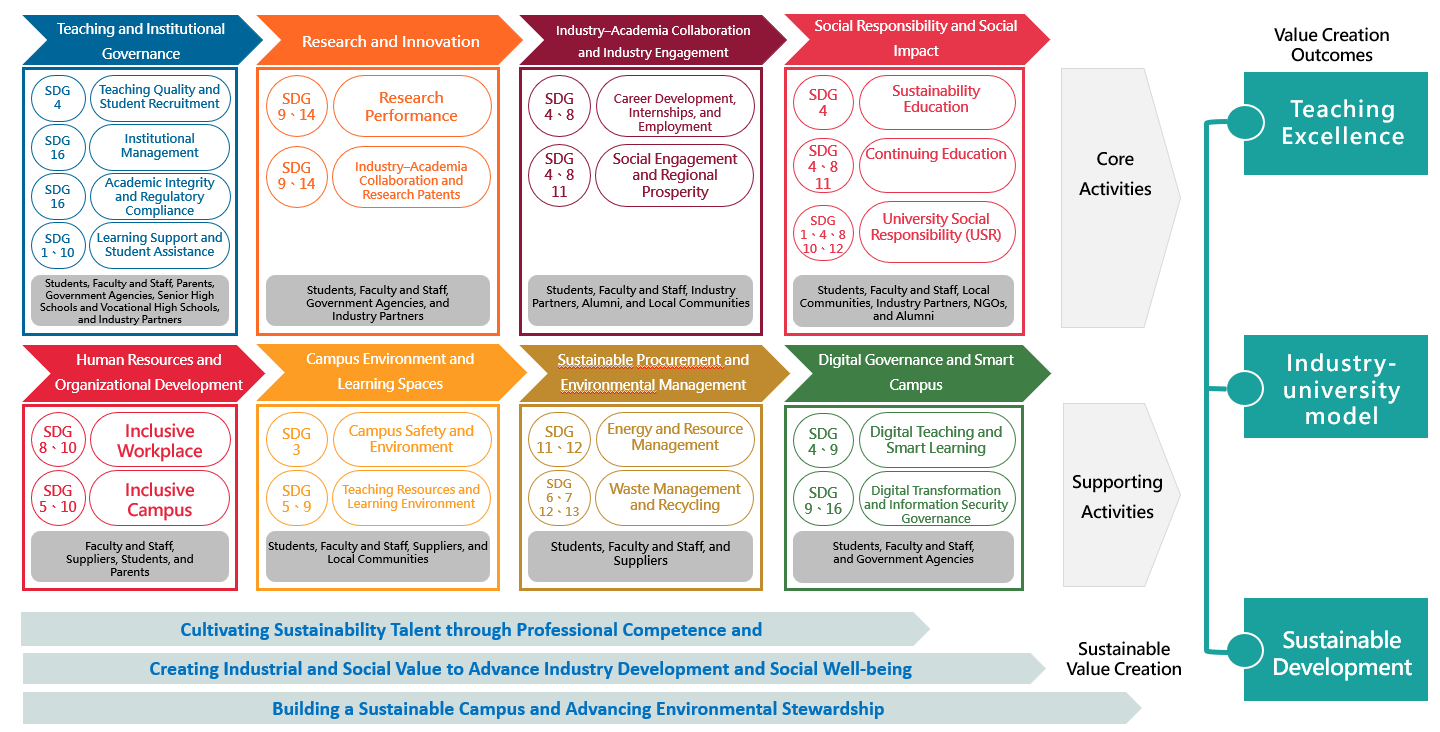
Since its founding, Cheng Shiu University has upheld its motto, "Striving for Excellence," with the mission of cultivating industry-ready professionals. The University has continuously integrated sustainability into institutional governance and educational practice. Through value chain analysis, Cheng Shiu University evaluates the impacts of its teaching, research, and campus operations on key stakeholders, including students, faculty and staff, local communities, and industry partners.
Cheng Shiu University Value Chain
Sustainability Vision and Strategic Priorities
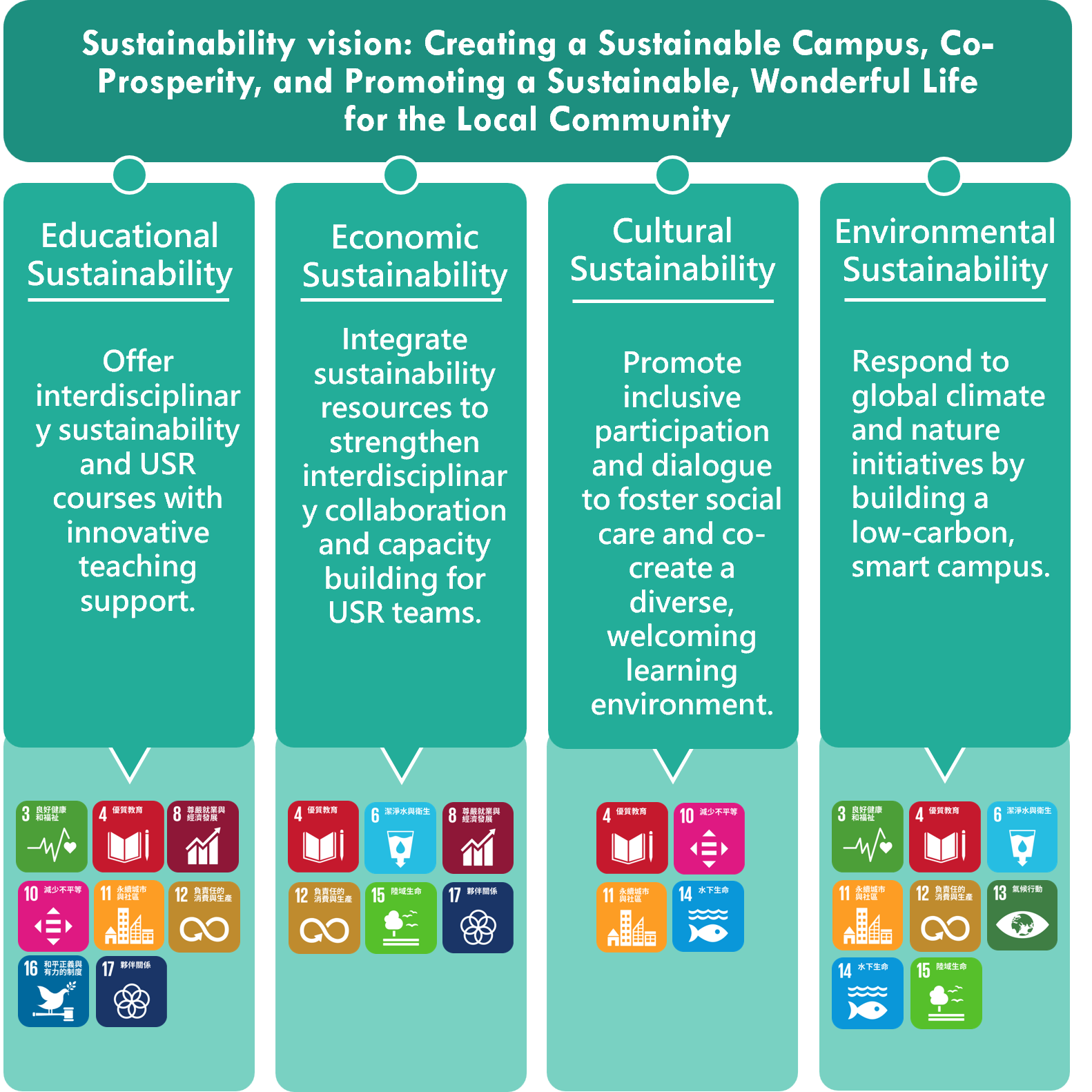
Guided by its vision of "Building a Sustainable Campus and Advancing Better Living for Local Communities," Cheng Shiu University integrates ESG, the SDGs, and Kaohsiung's net-zero governance framework to become a resilient, smart, and socially impactful university of science and technology.
The University focuses on four strategic priorities—Educational Sustainability, Economic Sustainability, Cultural Sustainability, and Environmental Sustainability. Centered on talent development, it advances environmental research, strengthens industry-academia collaboration, cultivates interdisciplinary problem-solving skills, fulfills its University Social Responsibility (USR), and supp orts Kaohsiung's net-zero transition.
Institutional Development Goals
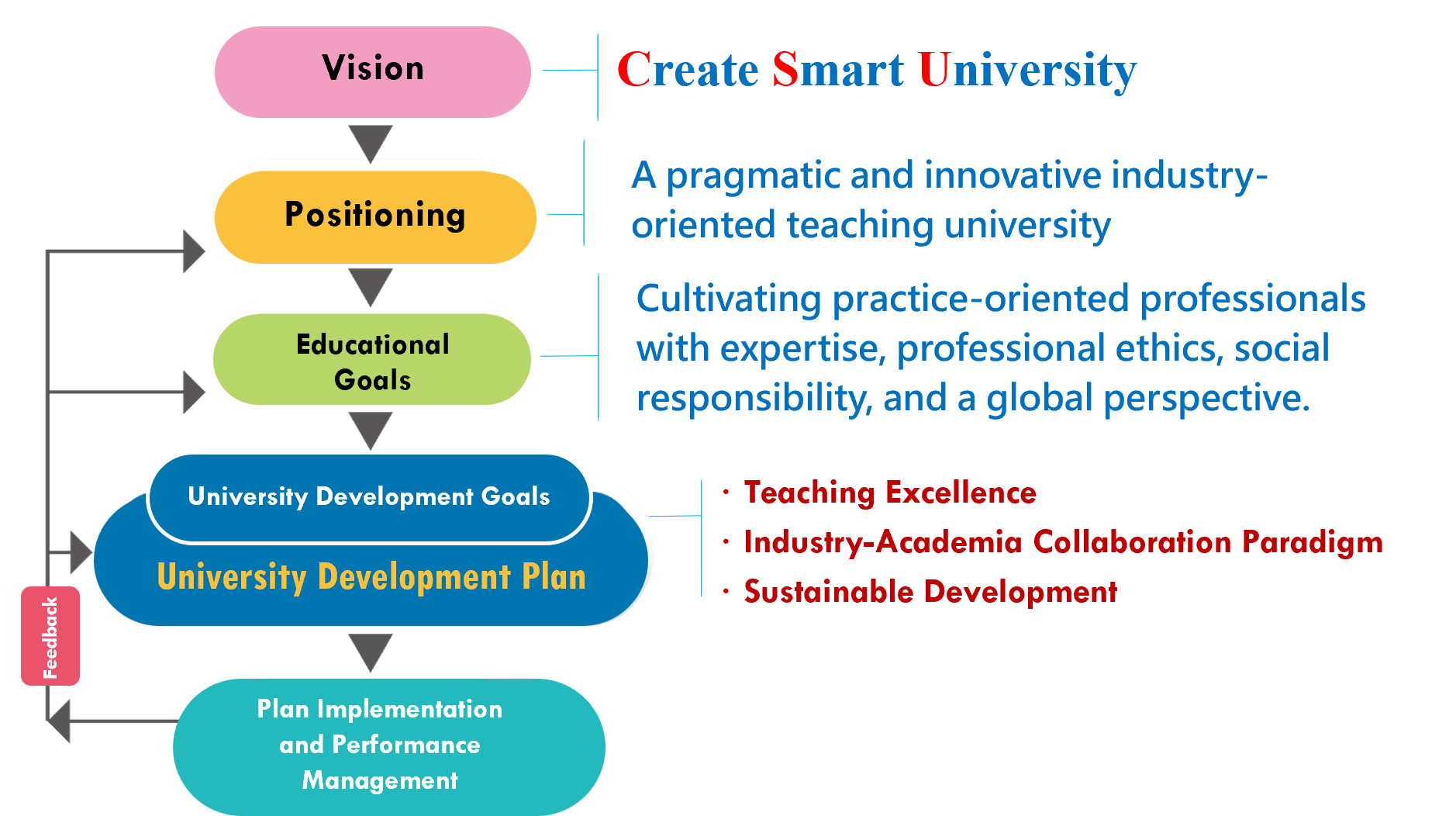
Cheng Shiu University advances sustainable development through three pillars: Learning Innovation, Teaching Innovation, and Institutional Innovation. Leveraging its strengths in teaching, research, and industry-academia collaboration, the University integrates innovation with practice and strengthens academia-industry links to cultivate professionals with expertise, professional ethics, social responsibility, and a global perspective. Guided by this vision, the University pursues three institutional goals: Teaching Excellence, Industry-Academia Leadership, and Sustainable Development.
Institutional Development Plan
To achieve its vision, Cheng Shiu University developed its Institutional Development Plan based on SWOT analysis and aligned with global trends, industry and societal needs, national development strategies, and education policies. The Plan focuses on three areas: institutional development, academic program development, and industry-academia research and development, providing a roadmap for sustainable growth. The framework is shown in the figure.
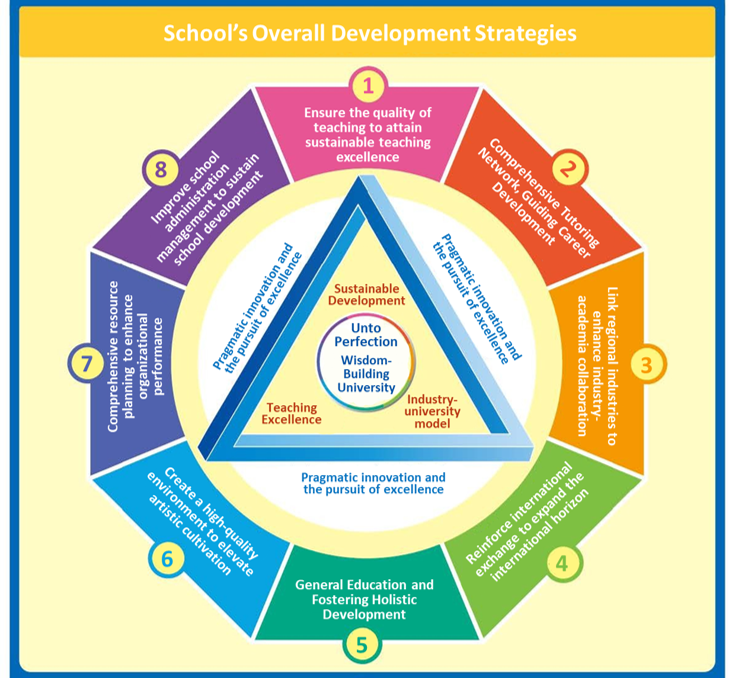
Alignment of the Institutional Development Strategy With the SDGs
|
Overall development strategies |
University Development Goals |
SDGs |
Responsible Unit |
|
Strategy one: |
Teaching Excellence |
|
Office of Academic Affairs |
|
Strategy two: |
Sustainable Development |
|
Office of Student Affairs |
|
Strategy three: |
Industry-Academia Collaboration Paradigm |
|
Office of Research and Development |
|
Strategy four: |
Teaching Excellence |
|
Office of International Affairs, Office of Research and Development (Center for Continuing Education) |
|
Strategy Five: Strengthening General Education and Fostering Holistic Development |
Teaching Excellence |
|
Center for General Education, Teacher Education Center, Office of Academic Affairs (Foreign Language Center, Physical Education Center), Office of Student Affairs (Military Training and Campus Security Center), Center for Teacher Education |
|
Strategy six: |
Industry-Academia Collaboration Paradigm |
|
Office of Library and Information Services, Office of Technology and Arts Development |
|
Strategy seven: |
Sustainable Development |
|
Office of Human Resources, Office of Accounting, Office of Student Affairs, Office of General Affairs |
|
Strategy Eight: |
Sustainable Development |
|
Office of the Secretariat, Office of Audit, Institutional Research Center, Office of Academic Affairs, Office of Admissions |


Sustainable Development Goals
Leveraging Applied Technical Expertise to Strengthen Regional Engagement and Advance Regional Sustainability and Net-zero Transition.
|
Item |
Short-term (1–3 Years) Establish sustainability governance and foundational management mechanisms. |
Medium-term (3–5 Years) Institutionalize sustainability governance and expand sustainability impact. |
Long-term (5–10 Years) Develop a net-zero campus and become a leading university in sustainability. |
|
University Governance |
Implement sustainability governance and management systems .Continuously enhance sustainability reporting with reference to international standards and sustainability rankings. .Integrate the sustainability reporting process into the internal control system. .Strengthen ESG data and sustainability information management. .Integrate the SDGs into the University Development Plan and KPI monitoring framework. |
Accelerate digital transformation and smart campus development .Implement an ESG performance management system to strengthen sustainability governance. .Enhance stakeholder engagement and the material topic management framework. .Establish an integrated sustainability information and ESG data management platform. .Develop digital governance and smart campus management systems. |
Sustainability Governance and University Development .Establish a smart sustainability governance model by integrating governance and decision-making systems. .Enhance institutional transparency and sustainability disclosure mechanisms. .Build an ecosystem for sustainability innovation and industry–academia collaboration. .Become a leading sustainability university in Southern Taiwan.
|
|
Environmental Sustainability |
Strengthen environmental sustainability education .Adopt the TCFD framework to regularly identify climate-related risks and opportunities. .Develop a net-zero campus roadmap and implement carbon reduction initiatives. .Replace aging equipment and improve energy efficiency. .Enhance the Campus Energy Management System (EMS). .Promote green procurement and circular resource management. .Strengthen campus environmental education and biodiversity conservation. |
Advance Green Transition and Build a Low-carbon Campus .Expand on-campus renewable energy installations (solar photovoltaic systems). .Increase the share of renewable energy to over 10%. .Enhance campus water resource management and circular waste management. .Implement a Smart Environmental Management System (SEMS). .Optimize smart energy and smart building management systems. |
Net-zero Campus and Environmental Sustainability .Advance the development of a Net Zero Campus. .Establish a smart low-carbon campus and sustainability demonstration site. .Develop a campus microgrid and increase renewable energy self-sufficiency. .Strengthen the campus carbon management system to implement the net-zero transition pathway. .Create an eco-friendly, low-carbon campus community. .Establish a smart low-carbon campus and sustainability demonstration site. .Develop a campus microgrid and increase renewable energy self-sufficiency. .Strengthen the campus carbon management system to implement the net-zero transition pathway. .Create an eco-friendly, low-carbon campus community. |
|
Social Inclusion |
Regional Engagement and USR .Strengthen regional engagement and University Social Responsibility (USR). .Adopt the Social Return on Investment (SROI) framework. .Provide financial aid and learning support for disadvantaged students. .Promote rural education, lifelong learning, and services for older adults. .Maintain a diverse portfolio of USR projects (Incubation, Seed, Sprout, and Deep Cultivation). .Enhance the quality of USR project implementation and community engagement. Sustainability Education and Talent Development .Integrate the SDGs into curricula to enhance sustainability literacy among faculty and students. .Promote innovative courses on sustainability and social responsibility. .Encourage student participation in sustainability clubs and USR initiatives. |
USR and Social Impact .Strengthen University Social Responsibility (USR) and social impact. .Prepare a medium- and long-term USR evaluation report to continuously monitor program outcomes. .Establish a USR impact assessment framework using Social Return on Investment (SROI). Sustainability Talent and International Engagement .Develop a sustainability talent development model integrating the SDGs, AI, and ESG. .Enhance support for student sustainability practice, innovation, and entrepreneurship. .Strengthen international sustainability exchange and collaboration. |
USR and Regional Prosperity .Establish a Kaohsiung USR Regional Revitalization Demonstration Hub. .Develop a collaborative model for university–community prosperity. .Continuously enhance the University's social impact and public value. Sustainability Talent and Lifelong Learning .Become a leading hub for sustainability talent development. .Promote intergenerational learning and lifelong learning platforms. Global Sustainability Engagement .Expand international sustainability partnerships and global connections. .Enhance the global sustainability impact of Cheng Shiu University. |