Stakeholder Engagement
Identification of Stakeholders
In accordance with the GRI Standards and the AA1000 Stakeholder Engagement Standard (AA1000SES), Cheng Shiu University identified 10 key stakeholder groups: students, faculty and staff, parents, local communities and the public, government organizations, NGOs, suppliers, Enterprises, alumni, and high schools.
To support the identification of material topics, senior executives completed a Stakeholder Assessment Questionnaire, evaluating stakeholders based on responsibility, influence, tension, diverse perspectives, and dependency. The results served as the basis for prioritizing and analyzing the University's material topics.
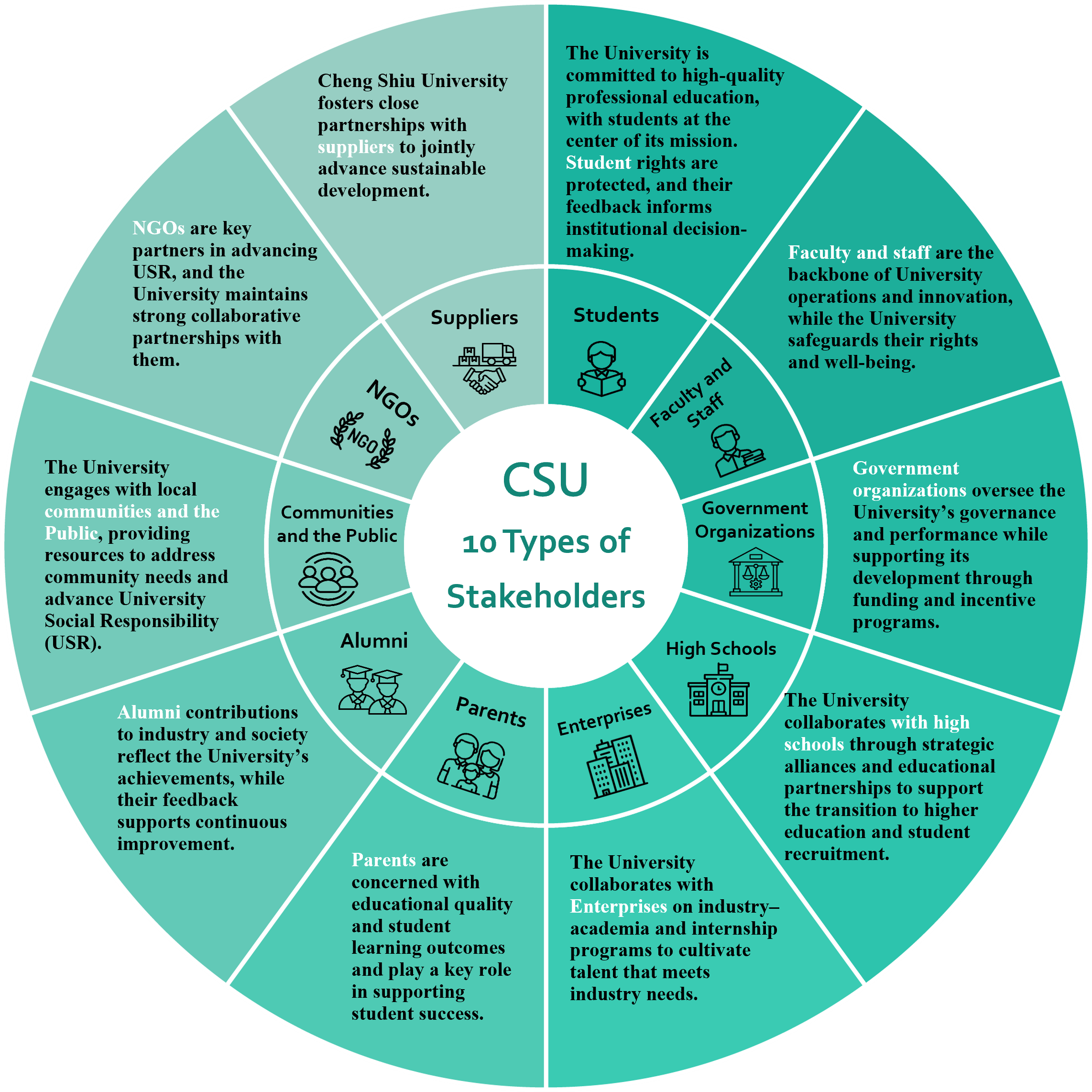
Stakeholder Engagement
Cheng Shiu University values stakeholder engagement. in addition to publishing its Sustainability Report, University Social Responsibility (USR) Report, and Accountability Report annually, the University maintains regular and ad hoc communication with different stakeholder groups through diverse engagement channels. It also operates the Cheng Shiu Sustainability Website to ensure effective stakeholder engagement.
|
Type |
Their Significance to Cheng Shiu University |
Communication method and frequency |
|
Students |
Students – Core beneficiaries of educational services; their learning outcomes, satisfaction, and development directly reflect the University’s mission. |
● University Affairs Proposal System (anytime) ● Advisor Meetings (weekly) ● Teaching Feedback Surveys (once per semester) ● Office of Student Affairs (anytime) ● Student Appeals Section (anytime) |
|
Faculty And Staff |
Faculty and Staff – Key drivers of teaching, research, and administrative excellence; their expertise and engagement ensure institutional quality and innovation. |
● resident’s Mailbox (irregular) ● Official CSU Website Announcements (irregular) ● Unit Email Accounts (irregular) ● University/Academic/Departmental Meetings (at least once per semester) |
|
Government Organizations |
Government organizations – Policy-makers and funding providers; their regulations, resources, and evaluations guide compliance and strategic alignment. |
● Official Correspondence (irregular) ● Participation in central or local government public hearings, workshops, forums, or briefing sessions (irregular) ● Submission of progress or final reports (irregular) ● Project Proposal Meetings (irregular) ● Evaluations, inspections, and site visits (irregular) |
|
High Schools |
High Schools – Talent sources and academic partners; collaborative programs strengthen student recruitment and academic pathways. |
● University Visits (irregular) ● On-campus Promotions (irregular) ● Enrollment Expos (irregular) ● Curriculum Articulation Seminars (irregular) ● Strategic Alliances (irregular) |
|
Enterprises |
Enterprises – Industry collaborators; provide internship, employment, and research opportunities, linking academia to market needs. |
● Signing Ceremonies (irregular) ● Industry-Academia (Internship) Matching / Briefings & Exchange Meetings (at least twice per semester) ● Curriculum Committee Meetings (at least once per semester) ● Industry-Academia / Industrial Alliance Meetings (irregular) |
|
Parents |
Parents – Supporters and evaluators of student development; their trust reinforces the University’s educational credibility. |
● Freshman Parent Orientation (once per academic year) ● Enrollment Prospectus (once per academic year) ● Annual Accountability Report (once per academic year) ● CSU Website & Email Communication (irregular) ● Parent Service System (irregular) |
|
Alumni |
Alumni – Brand ambassadors and resource contributors; maintain lifelong ties that benefit institutional growth. |
● Alumni Association Board Meetings (at least once per year) ● Department Alumni Gatherings (irregular) ● Alumni Homecoming Events (irregular) ● University Anniversary Celebration (once per year) ● Graduate Employment Tracking Surveys (once per year) |
|
Community And the Public |
Communities & the Public – Beneficiaries of outreach, cultural, and social responsibility programs; their feedback shapes local engagement. |
● Local Briefings (irregular) ● Community Collaborations (irregular) ● Event Participation (irregular) |
|
Non-Governmental Organizations(NGO) |
Non-Governmental Organizations (NGOs) – Strategic partners in sustainability, community service, and advocacy projects. |
● Public Welfare Cooperation Meetings / Signing Ceremonies (irregular) ● Lectures & Workshops (irregular) ● Advocacy Platforms (irregular) |
|
Suppliers |
Suppliers – Providers of goods and services; their collaboration impacts operational efficiency, sustainability practices, and compliance. |
● Signing Ceremonies (irregular) ● Procurement Evaluation Meetings (irregular) ● Supplier Briefings (irregular) |










Key Communication Focus & Response Actions & Communication Outcomes
| Type | Key Communication Focus | Response Actions & Communication Outcomes |
|
Students |
● Course quality and learning outcomes ● Internship and employment opportunities ● Living support |
.Teaching evaluations averaged 4.5/5 in the first semester of AY2025, reflecting sustained teaching quality. .A total of 35 interdisciplinary programs were offered in AY2024 to foster cross-disciplinary competencies. .A Sustainability Micro-Credential Program was launched to advance sustainability and University Social Responsibility(USR). .Off-campus internship programs were expanded to strengthen industry partnerships and increase internship opportunities. |
|
Faculty And Staff |
● Teaching resources ● Research support ● Promotion and career development ● University governance participation |
.Faculty development and innovative teaching were promoted through teaching practice research, faculty communities, and teaching grants. .Faculty with low teaching evaluation scores were reduced to fewer than five, with affected courses reduced to 20. .All eight faculty members scheduled for industry training or service in 2025 completed the program, achieving a 100% completion rate. .Teaching assistant training was strengthened to enhance mentoring effectiveness and peer learning support. |
|
Government Organizations |
● Regulatory compliance ● Policy response ● Project outcomes ● Social responsibility implementation |
.The University has received Ministry of Education Higher Education Sprout Project funding for eight consecutive years. in 2025, it secured NT$240 million—the highest among Taiwan’s private universities of science and technology. .The University and all 19 academic programs passed Ministry of Education evaluations, demonstrating a strong teaching quality assurance system. .In 2025, the University received the Ministry of Education’s Distinguished School Award for Special Education Services and Outstanding School Award for Student Drug Abuse Prevention. |
|
High Schools |
● Further education guidance ● Specialized courses ● TVET alignment |
.The University strengthened curriculum articulation and teaching collaboration with senior and vocational high schools in southern Taiwan to promote educational resource sharing. .Seven discipline-based competitions, hands-on workshops, and career exploration programs were organized to help senior and vocational high school students explore future study and career pathways. .Most students come from Kaohsiung, Pingtung, and Tainan. in AY2025, enrollment reached 14,623, ranking first among private universities of science and technology in Taiwan. |
|
Enterprises |
● Research technology ● Industry-academia collaboration ● Talent demand and matching ● Internship system |
.Industry professionals co-teach courses and supervise capstone projects, with over 250 industry-integrated courses offered annually. .In 2025, the University completed 1,603 industry–academia projects, securing over NT$390 million in funding. .The University ranked among Taiwan’s Top 5 in the 2025 Cheers Employer Favorite University Rankings. .The University also ranked among Taiwan’s Top 5 for R&D in the 2025 104 Job Bank University Brand Rankings. |
|
Parents |
● Student learning outcomes ● Tuition and financial aid ● Career development ● Campus safety |
.Career development programs attracted 4,682 participants across 78 events in AY2024. .In 2025, the University partnered with the Ministry of Labor to host a campus job fair, with 100 employers offering over 5,000 job opportunities and achieving 946 on-site job matches. .Financial aid and scholarships totaling NT$70.98 million benefited 10,969 students in AY2024. .A parent service platform strengthened parent–University communication and trust. |
|
Alumni |
● Alma mater development ● Workplace networking ● Resource contributions |
.The Alumni and Career Development Center strengthens alumni engagement, philanthropy, and support for teaching quality and student learning. .Departments establish alumni associations and host career-sharing events to connect students with industry insights and labor market needs. .Alumni feedback is used to enhance teaching quality. Graduates from AY2022 (one year after graduation) reported an employment satisfaction score of 4.23 out of 5. |
|
Community And the Public |
● Local issue collaboration ● Space sharing ● Resource support |
.The University operated 18 USR practice sites in 2025, connecting 211 community and industry partners. .Academic departments and student organizations engaged in community service for underserved and rural areas, strengthening social engagement. .The 2025 Digital Learning Companion Program supported six rural schools, promoting equitable access to educational opportunities. .The Business Incubation Center continued to support startups, hosting 21 companies and graduating two enterprises in 2025. |
|
Non-Governmental Organizations(NGO) |
● Social issue collaboration ● Sustainability advocacy ● Youth engagement |
.The University partnered with NGOs to advance USR and expand its social impact. .The Community Co-learning Program engaged local organizations in community service initiatives. .The Dream Fulfillment Social Service Program, in partnership with the Huashan Social Welfare Foundation, established a cross-sector social service alliance. .The University launched the Happiness Bus school shuttle through a NT$150,000 joint donation, providing safe transportation for students in remote Indigenous villages of Pingtung County. |
|
Suppliers |
● Fair trade ● Quality assurance ● Sustainable procurement |
.The University implements transparent procurement and supplier management, achieving a 98.52% local procurement rate with 1,337 local suppliers in 2025. .Green procurement is promoted by prioritizing eco-labeled and energy-efficient products, with total purchases reaching NT$26.29 million in 2025. .The University strengthens suppliers’ sustainability awareness and performance to enhance supply chain transparency and environmental performance. |