Academic Ethics
Academic Ethics Management
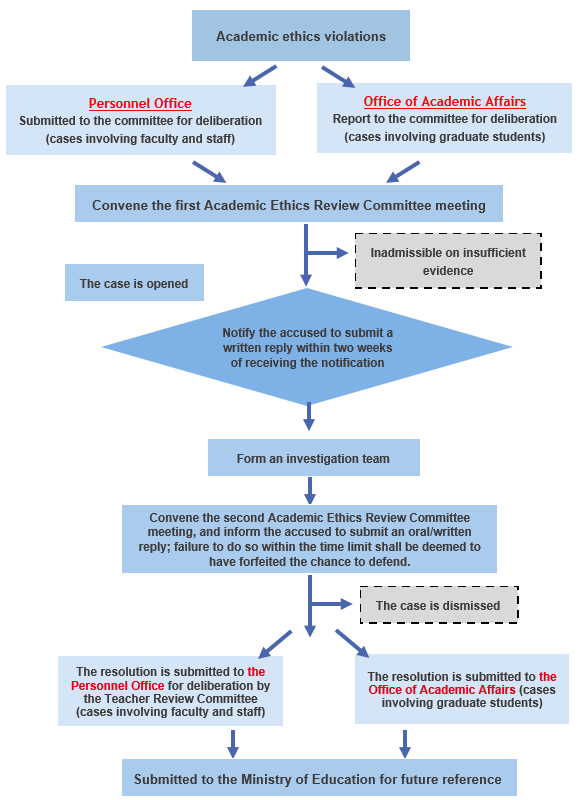
The University maintains academic integrity through its Academic Ethics and Self-Regulation Principles and Degree Thesis Review and Quality Assurance Guidelines. an Academic Ethics Review Committee impartially reviews reported violations.
Reported cases are referred to the Office of Research and Development and, upon presidential approval, submitted to the Committee. Cases accepted for review are investigated by a dedicated panel. One academic ethics violation was reported in 2025. the University will continue strengthening ethics education and governance mechanisms to uphold academic integrity.
◎ Key Principles of Academic Ethics
|
Adherence to Academic Ethics |
Faculty strictly comply with academic ethics in research and teaching, prohibiting fabrication, falsification, plagiarism, ghostwriting, misappropriation, or any other misconduct. |
|
Thesis Quality Assurance |
Faculty guide students in accordance with the Degree Conferral Act, university regulations, and thesis review guidelines to uphold higher education quality and academic integrity. |
|
Promoting Academic SelfDiscipline |
Faculty lead by example, fostering a culture of honesty and integrity, and actively participate in academic ethics training offered by the university and the Taiwan Academic Ethics Education Resource Center. |
Academic Ethics-Related Cases Handling Procedure
Academic Ethics Education
The University promotes academic integrity through its Academic Research Ethics Course Guidelines, Graduate Degree Examination Regulations, and Thesis Review and Quality Assurance Guidelines.
Faculty and students complete certified online courses and participate in ethics training offered by the University and the Southern Taiwan Research Ethics Alliance. in 2025, 100% of master’s and doctoral students met the academic ethics training requirements.
|
Faculty |
Full-time, project-appointed, and technical faculty must complete at least six hours of academic ethics training every three years; new faculty must complete the training within their first year. |
|
Students |
Master’s and doctoral students must obtain the Ministry of Education’s academic ethics course certificate by the end of their first semester before applying for a degree examination. Undergraduate and junior college teaching assistants must also complete academic ethics training. |
Academic Ethics Education Course Participation
|
Undergraduate and Junior College |
|||
|
Academic Year |
Number Completed |
Number Required |
Participation Rate (%) |
|
2022 |
146 |
180 |
81.11% |
|
2023 |
140 |
167 |
83% |
|
2024 |
121 |
153 |
79% |
|
Graduate Institute |
|||
|
Academic Year |
Number Completed |
Number Required |
Participation Rate (%) |
|
2022 |
291 |
291 |
100% |
|
2023 |
263 |
263 |
100% |
|
2024 |
263 |
263 |
100% |